René Descartes (1596–1650)
Biography
- Father or Modern Philosophy, mind/body dualism, cogito ergo sum, skeptical doubt elevated to philosophical method (bracketing)
- René Descartes (1596–1650), cusp Medieval → Modern; organic cosmos → mechanistic universe
- Life spans Thirty Years' War (1618–48), Europe's worst religious-political conflict, hardened Catholic-Protestant split
- Height of Scientific Revolution: Copernican heliocentrism, Galileo's 1633 trial spooks Descartes into suppressing what he was writing (endorsed Copernican heliocentrism)
- Left France partly to escape scholastic-Church control; worked mainly in Dutch Republic, rare zone of intellectual freedom/printing tolerance
- Died Stockholm 1650, pneumonia, tutoring Queen Christina who insisted on early morning lessons
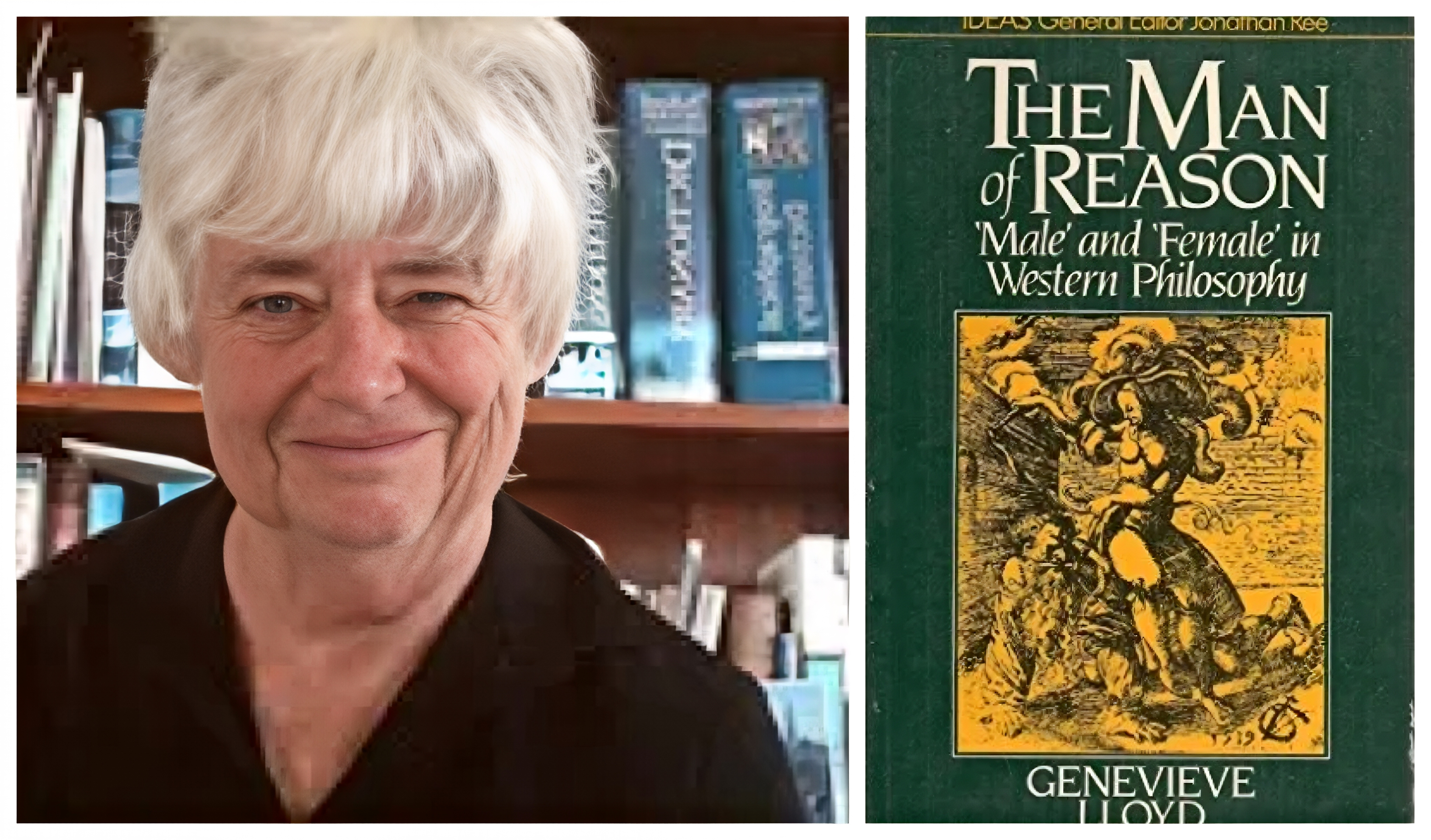
Genevieve Lloyd (1941–)
"Reason as Attainment" — Traces how Descartes's method, despite his genuinely egalitarian intentions, transformed Reason from a universal human trait into a rare, disembodied achievement, helping produce women:body/emotion :: men:mind/abstract intellect.
Optional piece: Leslie Heywood, "When Descartes Met Fitness Babe." Weaves personal memoir, film analysis, and Cartesian theory to argue that the mind-body split underlies both clinical anorexia and contemporary gym/consumer culture's disciplined, "masculinized" self-shaping of the female body.
Biography
- Australian philosopher, first female professor of philosophy in Australia at the University of New South Wales
- The Man of Reason (1984) — argues Western reason symbolically coded male; traces through Plato, Descartes, Kant, Hegel
- Later work: Spinoza and time (influences the Australian Feminist Phil school, Elizabeth Grosz, Moira Gaitens)
- Debt to Beauvoir, but critiques Beauvoir's use of "transcendence" as ideal in Man of Reason
- New book!, Land and Country, published December 24, 2026 — her own family's history of convict descent, the violence of settlement, current debates over identity, sovereignty, and belonging
Main Discussion Points
- What is Thinking? Descartes' Method, Cartesian Skeptical Doubt
- Ancient Soul/Body → Modern Mind/Body
- Princess Elisabeth of Bohemia's Challenge
- New Era, New Man-Subject
1. What is Thinking? Descartes' Method, Cartesian Skeptical Doubt
Review: We have seen three models for thinking:
- Collection and Division: Angler example from Plato's Sophist, a late dialogue thought to be properly Platonic — A and not-A, dualism, binary thinking
- Dialectics: Diotima's discourse on love and the daimonic — interval, third term in-between, two opposites, binary, dualism
- Aristotle's taxonomical definition: a pencil is a writing instrument that uses carbon to make its marks, often made of wood. End of pencil is to write legible marks, a pencil that can't write legible marks is a bad pencil; end or goal oriented.
- Cartesian method of radical doubt, bracketing the outside world to go inside — becomes phenomenological method of epoche (or bracketing) with Husserl's Cartesian Meditations (Edmund Husserl, 1859–1938) → grounding Merleau-Ponty & Beauvoir
Descartes' Transformation of Method: The Philosopher becomes the Scientist
- Keeps word "method," changes meaning
- Socratic/Aristotelian tradition, method = reasoned way of pursuing a particular activity, logic internal to the subject matter
- Descartes' method goes inward; aims at certain, objective knowledge; truth is not out there, but in here, fixed by the mind's natural operations (or structures), not by the pursuit's ends (teleological)
- Knowledge, derived from pure reason, is precisely ordered, abstract thought; uniform across every subject
- Example: Aristotle's Virtue Based Ethics vs. Kant's principle based ethics (deontological, duty)
Question: Descartes claims certainty must come from the mind's own fixed structure, not from the variable ends of different pursuits. What's lost when method gets detached from its subject matter?
Lloyd: unified method ← mind/body separation
- Bodily skills interfere with one another (farm-labor hand ≠ harp hand) — body permits only one habituation at a time
- Sciences, by contrast, are purely mental exercises, mastering one truth helps discover others
- Sciences target the unity of Reason itself; interior structure of a new subject
- Only holds if divinely guaranteed correspondence between mind and reality (mental structure = reality's structure)
- Clarity/distinctness of truth (which needs no defense); self-apparent
- Knowledge is subtractive, remove messy body/material
Question: Have you ever noticed your own body "interfering" with itself — like how being great at one physical skill can make a different physical skill harder? Do you think thinking works the same way, or is Descartes right that mental skills don't compete with each other like that?
2. Soul/Body → Mind/Body
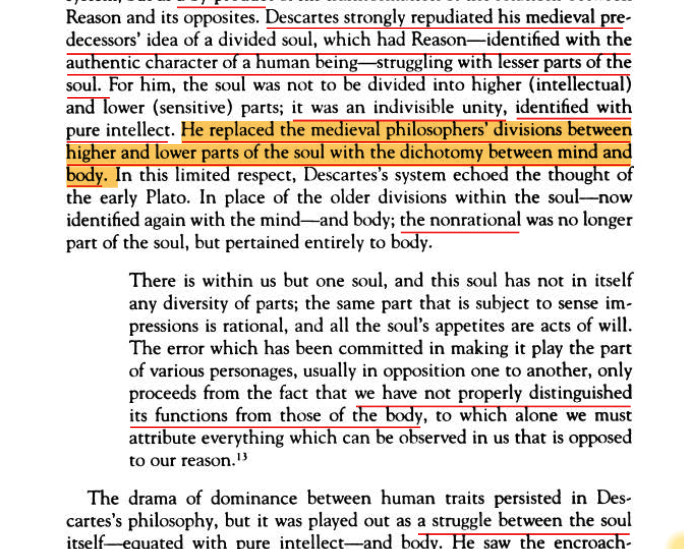
Mechanism: rejection of medieval divided-soul model
- Old model: one soul, higher/rational part vs. lower/sensitive part (internal contest)
- Descartes: soul = indivisible unity, identical w/ pure intellect
- Realignment: reason vs. "opposites" → now mind vs. body (sharpest possible metaphysical division)
- Consequence: truth-securing thought becomes rarefied, restricted activity
- true clear/distinct thinking (foundation of science) = only small portion of well-spent life
- for Descartes himself: a few hours a year
Formal equality
- Formally: no differentiation between male/female minds — both equally endowed w/ natural light of reason
- But real social conditions block formal equality → equal access
- For Descartes (as for Bacon): science is a collective enterprise, requires institutional participation — women excluded from this
Conceptual (not just social) roots of division
- Beyond social obstacles: something in the philosophy itself supplies lasting resources for sexual division of mental labor
- Descartes insists Reason equally present in everyone, "even women" — but more influential legacy = ideal of abstract, disembodied thought, separable from emotional/practical life
- This ideal + pre-existing male/female social role distinctions → opens way to imagining genuinely different male/female modes of consciousness
- Result: women associated w/ sensuous realm; "Man of Reason" must transcend it
- Arrangement possible precisely because Reason (highest sense) is an achievement — attained, not a birthright

3. Princess Elisabeth of Bohemia (1643) — Challenge to Descartes' Mind-Body Division
Cf. Lilli Alanen, "Descartes and Elisabeth, A Philosophical Dialogue?" — argues the Descartes–Elisabeth correspondence is a genuine, mutual, Socratic philosophical dialogue rather than a mentor-student exchange, with Elisabeth's persistent questions exposing real gaps in Cartesian dualism.

Focus on: Descartes-Elisabeth correspondence (from 1643)
- Elisabeth: persistent illness — slow fever, dry cough
- Mentor/"Doctor" Descartes' diagnosis (at distance): cause = sadness at family misfortunes
- cure in her own power — render soul content despite fortune's disgraces, body follows
- Advice = Stoic in structure/confidence
- Classical Stoicism: divides world into "up to us" (judgments, assent) vs. not (health, wealth, others' actions)
- freedom located in what is "up to us"
- Descartes' move: grafts Stoic architecture onto his physiological mind-body theory
- "principle of natural institution" — thoughts/bodily movements linked, retrainable via habit
- reason can govern the passions it's causally entangled with
- Stoic will-confidence + Cartesian dualism → unabashed optimism about reason mastering passions
Elisabeth's pushback
- Rejects prescription — speaks from lived experience of illness
- body's weakness → oversensitive to soul's afflictions
- recurring misfortune keeps destabilizing reasoned peace of mind
- Social Conditions Argument: Princess Elisabeth tells Descartes: running her household leaves her too depleted; can't sustain the meditation habit his method requires
- Conceptual Argument, a sharper logical point: passions + reason are both body-dependent
- body can be deranged by disease
- no guarantee reason keeps its assumed sovereignty
- some illness removes the very capacity for rational judgment the Stoic-Cartesian program requires
- Descartes' eventually concedes this conceptual point; first admission that circumstances outside our control can block reason's free use; but does not restructure his theory
- Alanen's credit to Elisabeth: first to expose how little grounds for optimism Descartes' own mind-body union actually gives
Question: Where else in the history of philosophy does a woman's lived experience function as the pressure that exposes a canonical system's blind spot?
4. New Era, New Subject
Descartes' Radical Skepticism or Doubt
- Descartes uses doubt as a demolition tool with an exit: doubt everything methodically, hit the one thing that can't be doubted (the cogito ergo sum), then rebuild certain knowledge from there
- mind/body dualism: invisible/visible; time/space; interior/exterior(extended); transcendence/immanence, etc.
- Maps onto gender: masculinity/femininity
Question: Lloyd argues the damage isn't just social exclusion from institutions but something built into the philosophy itself — the ideal of abstract, disembodied thought is masculinist. Do you find the conceptual argument or the social-conditions argument more persuasive, or are they inseparable?
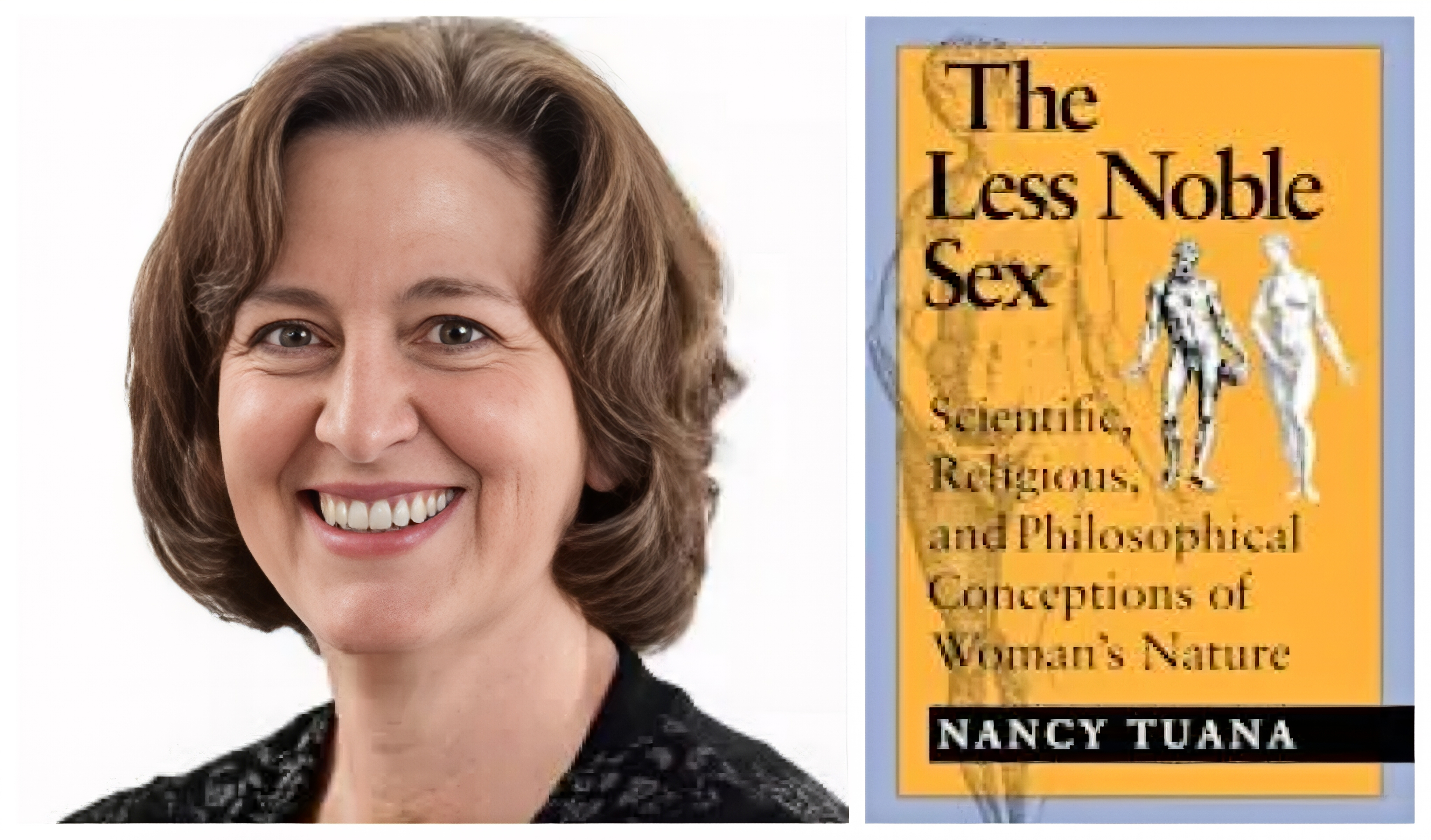
Nancy Tuana
Nancy Tuana, The Less Noble Sex: Scientific, Religious, and Philosophical Conceptions of Woman's Nature (Indiana University Press, 1993) — excerpted section: "Without Good Reason: Defining Reason as Male: Descartes," from the chapter "The Weaker Vessel," pp. 60–64.
Shows that although Descartes explicitly held reason to be equal in all people, his mind-body dualism combined with women's embodiment, social role, and (for poor/enslaved women) class and race to make the "rational person" effectively male, upper-class, and European.
Descartes' Method
- Certain knowledge reached by breaking complex beliefs into simple, self-evident elements, then tracing how they combine
- method applies uniformly across every domain — all knowledge fundamentally same in kind
- Two crucial assumptions: reason mirrors structure of reality; clear and distinct ideas = genuine sources of truth about the world
- To secure both: Descartes needs a guaranteeing God — one who structured mind and world correspondingly
- Clear traces of Christian doctrine: man made in God's image
- rational knower achieves something like a "god's-eye view" → objective, scientific knowledge possible
- Knowledge = objective, purged of anything merely subjective (i.e., purged of senses and imagination);subtractive
Mind/Body
- Senses and bodily needs fluctuate → certainty can only come from something purely mental
- Body not neutral — an active impediment to knowledge
- Only activities that fully transcend it (mathematics, philosophy, the sciences) count as genuine sources of truth
- Mind defined narrowly as a thinking substance
- passions explained mechanistically — products of bodily "animal spirits"
- emotion excluded from the mental altogether, recast as source of error rather than insight
- Rationality difficult, requires rigorous training — but anyone can achieve it; Descartes's rational subject looks gender-neutral
- Beneath this surface universality: the rational person is, in practice, male
- Women associated with body through reproduction
- women's social role — daily demands of household/childrearing leave little room for sustained leisure (cf. Princess Elisabeth of Bohemia)
- maternal care defined by attentiveness to each child's particular needs — direct tension with Cartesian ideal of reason
- class and race: enslaved, laboring, or otherwise non-leisured women even further handicapped
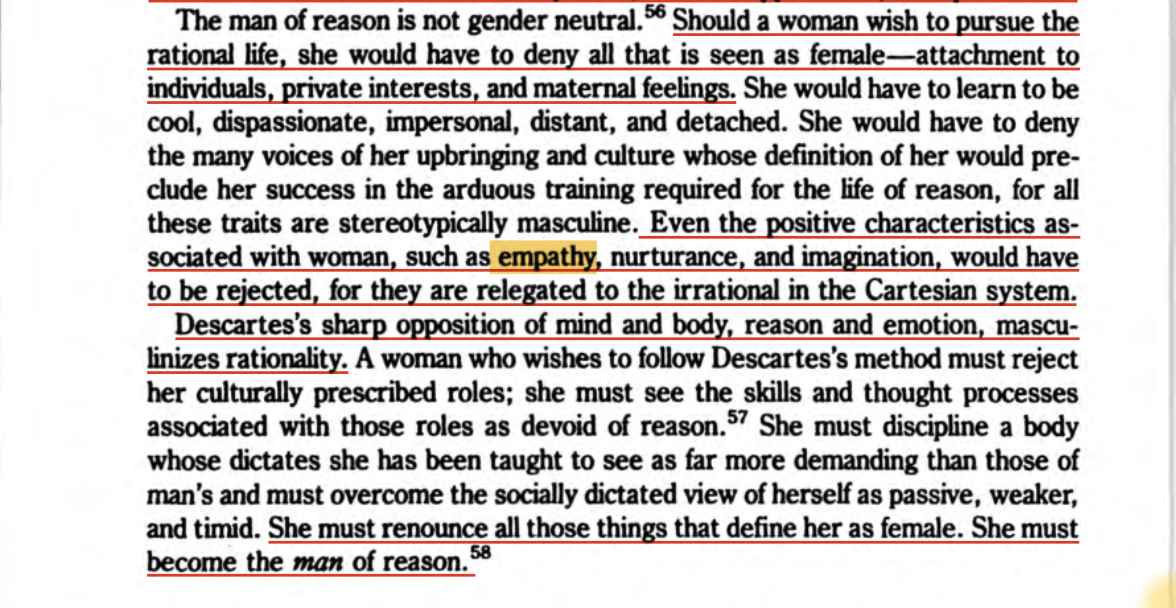
- A woman pursuing the Cartesian rational life would have to reject everything culturally coded as female (attachment to individuals, private interest, maternal feeling) and adopt coolness, detachment, impersonality coded as masculine
- Even positive traits associated with women (empathy, nurturance) would have to be discarded
- Descartes's sharp opposition between mind/body, reason/emotion effectively masculinizes rationality itself
- A woman following his method must renounce everything that defines her as female — in Tuana's phrase, "become the man of reason"
Coda: The Birth of the Modern Subject, carving out the interiority of subjectivity as temporality
- Medieval cosmos: organic, hierarchical, continuous, "ensouled" world -> ghost in a machine
- mind becomes radically interior, sealed off, one island of thinking substance in a universe of dead machinery
- matter is pure extension: inert mechanism, quantifiable, no interiority of its own
- modern subject: private, introspective, temporally continuous "I", center of his/her own world
*Questions:
- Does bracketing the "outside world" to go inward (→ later Husserl) solve the skeptical crisis, or just relocate it?
- Is the "New Subject" that emerges from that escape necessarily a gendered one, or could Reason-as-attainment have cut a different way?
- *Who in your own life had less "leisure" or mental space to sit and think deeply — and at what cost?