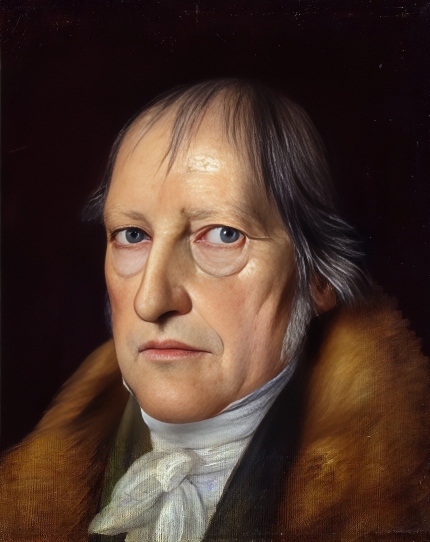
Georg Wilhelm Friedrich Hegel (1770-1831)
Biography
- Georg Wilhelm Friedrich Hegel (1770-1831)
- Studied theology and philosophy, roomed with Friedrich Hölderlin and Friedrich Schelling
- Married Marie von Tucher in 1811 (she was 20 years younger)
- Chair of Philosophy University of Berlin from 1818
- 1831 death of cholera, or some gastrointestinal illness
- Phenomenology of Spirit (1807), Science of Logic (1812–1816), Elements of the Philosophy of Right (1820)
Philosophical Context
- School of German Idealism: reality is fundamentally structured by mind or reason; freedom is achieved through the systematic self-development of thought and subjectivity. Sound familiar? (Kant, Fichte, Schelling, Hegel). Culminates in Hegel who sees his philosophy as the full inversion of Plato, proclaiming the end of history with the birth of "the modern state."
- Some core ideas: dialectic (thesis-antithesis-synthesis); master-slave dialectic; the rational as the real, and the real as rational
- Account of subjectivity: Master-Slave dialectic describes how undifferentiated consciousness becomes differentiated self-consciousness; basis for phenomenology, existentialism, Marxism, many feminist accounts since Beauvoir, and more.
- Standard issue misogyny: Philosophy of Right §166 is the key text: women belong to the sphere of the family and a pre-political, ethical feeling, governed by natural/immediate unity; men belong to civil society and the state, governed by mediated, universal rationality achieved through struggle.
- Infamous analogy at §166: women relate to the state the way plants relate to animals, theirs is an unthinking, intuitive "vegetative" mode of ethical life.
- His reading of Sophocles' tragedy Antigone is major treatment of woman as the "everlasting irony of the community," dependant on her labor, but ultimately superseded in the move to political unity, with the state/law.
Historical Context
- Hegel 1770-1841
- Olympia de Gouges 1748 - 1793 (Declaration of the Rights of Woman and of the Female Citizen in 1791)
- Haitian Slave revolt 1791 (Hegel is 21)
- Mary Wollstonecraft 1759 - 1797
- A Vindication of the Rights of Woman: with Strictures on Political and Moral Subjects is a 1792
- Denmark was the first European nation to abolish the slave trade in 1792, followed by the United Kingdom and Germany in 1807 and France in 1815; US Emancipation Proclamation issued by Lincoln in 1863, extended to confederate states 1865 with 13th Amendment.
- Phenomenology of Spirit (1807)
- US Seneca Falls Convention in 1848
Let's Spit on Hegel
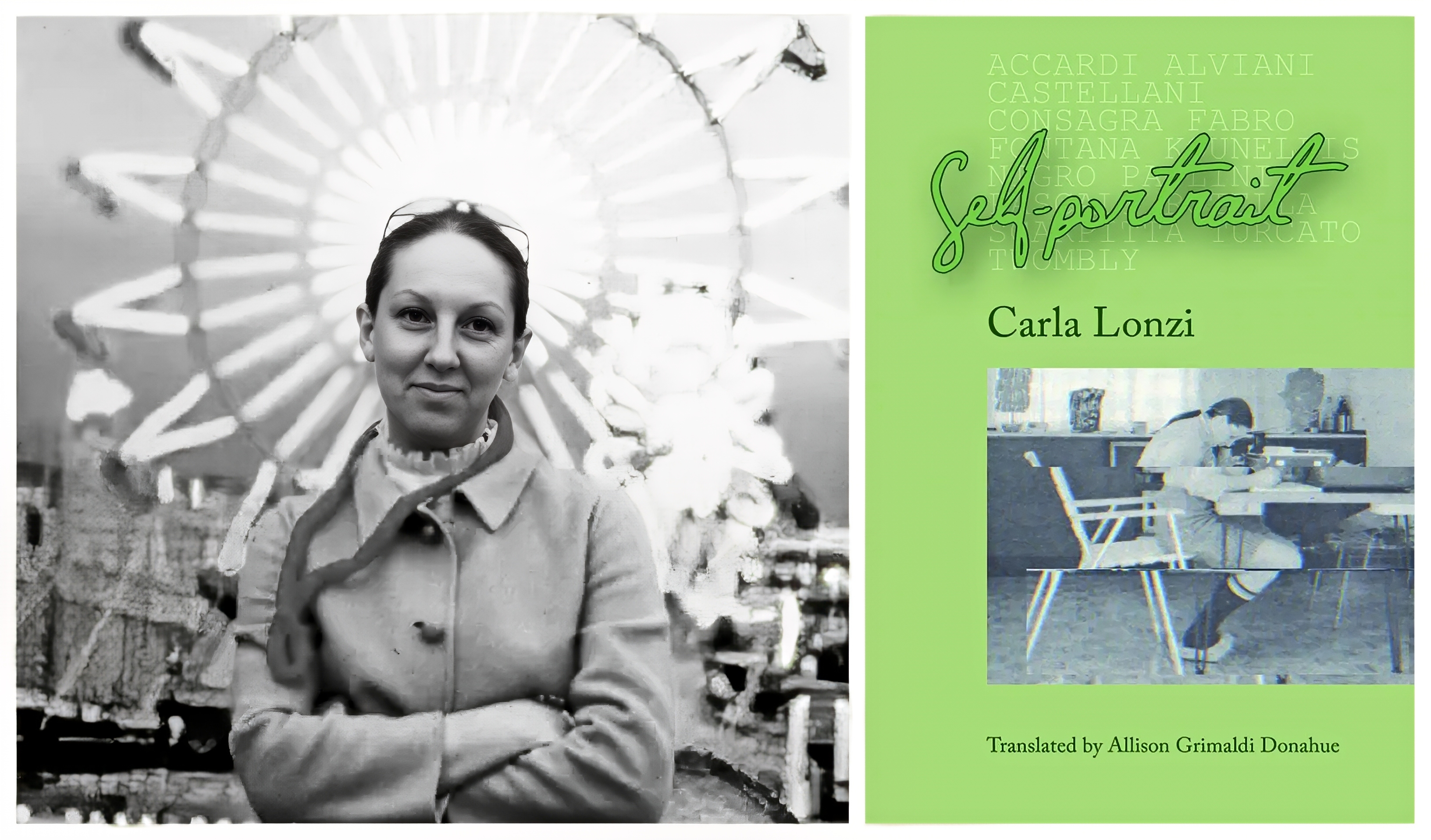
Carla Lonzi (1931-1982)
- Italian feminist and art critic,
- 1969 book Autoritratto (Self-Portrait) says goodbye to art crit world
- 1970 she co-founds the feminist collective Rivolta Femminile with artist Carla Accardi and journalist Elvira Banotti
- Sputiamo su Hegel [Let's Spit on Hegel] is a manifesto written in that same year, 1970
- Giovanna Bellesia and Elaine Maclachlan new translation for the Feminist Interpretations volume introduced her to many feminist philosophers (me!)
- Considered an important figure in European feminism; her art criticism work overlooked until very recently
- Manifesto: a polemical, declarative form of writing that is meant to bring into the world a group/idea, often a rupture or countercultural. Designed to provoke and mobilize, to action. Art manifestos are common in the late 60s early 70s political movements.
What does Let's Spit on Hegel want us to do? As a Manifesto?
I. Neither Equality nor Difference Framework
- "Equality" and "difference" as two competing frameworks that men have always offered women as the only two options, but the framework itself is the trap, regardless of which side you pick
- Woman's oppression does not begin in historical time; Capitalism inherits the oppression of women (p.277); the archetype of property is the ownership of women as sexual object/women's labor.
- Equality is juridical, not sufficient: "Equality is what is offered to the victims of colonization... what is imposed on them on the level of culture. It is the principle by which those who exercise hegemony continue to condition those who do not." (p.277)
- Difference is an "existential principle...concerning modes of being human, the peculiarities of our experiences, our ends, our possibilities..." (p.276)
- "The difference between woman and man is the fundamental difference of humankind" (p.277)
- "Women do not have one reason, not one single reason any more, to endorse the objectives of men. In this new stage of awareness women reject, as a dilemma imposed by male power, both equality and difference." (p.277)
II. Master-slave model rejected
- "Hegel's master/slave relationship is a relationship internal to the male human world" (p.279); "The Phenomenology of Spirit is a phenomenology of the patriarchal spirit" (p.281)
- Hegel, "more insidiously than others, rationalized patriarchal power in the dialectic between a divine feminine principle and a human male principle. The first principle presides over the family, the second over the community": "Since the community only gets an existence through its interference with the happiness of the Family, and by dissolving (individual) self-consciousness into the universal, it creates for itself in what it suppresses and what is at the same time essential to it an internal enemy, womankind in general." (Hegel, qtd. p.278)
- Beauvoir was mistaken to adopt the master-slave model: "Forcing the woman question into a master-slave concept of struggle, such as the class struggle, is a historical mistake." (p.279)
- Communism/Socialism is congruent with the traditional family, not a solution: "Marxism dealt with the master-slave dialectic as the fundamental contradiction in the development of bourgeois society, and articulated this dialectic in terms of class struggle. But the dictatorship of the proletariat has sufficiently demonstrated that it is not the bearer of the dissolution of social roles: it maintained and consolidated the family as the central social institution continuously duplicating a human structure incompatible with any substantial change in values." (p.282-3); the political lie that communist or class revolution will bring about the liberation of women.
- "If Hegel had recognized the human origin of the oppression of woman, as he recognized the human origin of the oppression of the slave, he would have had to apply the master/slave dialectic to her case, too. And in so doing he would have run into a serious obstacle: in fact, although the revolutionary method of the dialectic can identify the movement of social dynamics, there is no doubt that women's liberation does not fit into the same pattern. On the level of the man-woman relationship there is no solution that eliminates the other, hence the seizure of power as a conclusive act becomes irrelevant." (p.281)
III. The Anxiety of Masculinity
- "What is this anxiety of men that runs gloomily throughout the history of humankind and always brings to a dead end all our efforts to escape the compulsory choice of violence? The male species has expressed itself by killing; the female species has expressed itself by working and protecting life... [Man institutionalizes] war as a safety valve for his internal conflicts [and this leads] us to believe that such conflicts are inevitable for man, a 'given' of the human condition. But the human condition of women does not manifest the same needs; on the contrary, women mourn the fate of their sons sent to die." (p.291)
- "Men are now on the verge of discovering that the essence of the human dilemma lies within themselves, in that rigid psychological structure of theirs that can no longer hold back its destructive cathexis. This is how the sensation of living in an irreversible crisis has established itself in the world, with the only alternative identified as the red flag of socialism... Men must leave this path to put an end to their historical role as protagonist. This is the change we are advocating." (p.293, my emphasis)
- "Man is wrapped up in himself, in his past, in his aims, in his culture. He thinks reality is used up; space travel proves this. But woman affirms that life must still begin for her on our planet. She sees where man no longer sees. The spirit of man entered a definitive crisis when it triggered a mechanism that touched the safety limit of human survival. Woman exits man's guardianship when she recognizes the heart of the danger in the very structure of the patriarch and his culture." (p.294)
- "The male species has constantly endangered life and is now endangering survival."
IV. Motherhood, maternal love, and the potential alliance between women and young men (pp.284-289)
-
"Motherhood, although distorted by the conflict between the sexes, by the impersonal myth of the continuation of the species, and by the forced dedication of a woman's life, has been a reservoir of thoughts and feelings, the locus of a special initiation. It is not the having of children that turns us into slaves: it is not the son that enslaves us, but the father." (p.284-5, my emphasis)
-
"Motherhood is the moment when, reliving the initial stages of life in emotional symbiosis with her child, a woman separates herself from culture. She sees the world as a product extraneous to the primary demands of the existence she is reliving. Motherhood is her 'trip.' The consciousness of a woman spontaneously returns to the origins of life and she questions herself." (p.288)
-
Woman's turn toward the young, away from mature/patriarchal men: "Young men are oppressed by the patriarchal system, but at the same time they present themselves as candidates for the position of oppressor; the outburst of intolerance of young men is thus characterized by an inherent ambiguity." (p.289)
-
Women and young men are natural allies against the patriarchal order, because both are oppressed by the same figure, the father/patriarch;women reject the patriarchal family and young men refuse to participate in war
-
Beyond the maternal, women can find genuine delight in natural exchange with the young more broadly, not confined to their own biological children or to sanctioned maternal roles
V. The New, Unexpected Subject
- "Woman as she is is a complete individual: the transformation must not take place in her, but in how she sees herself within the universe and in how others see her." (p.293)
- "Woman must simply claim her own transcendence. Philosophers have really talked too much." (p.295)
- "Woman has had enough of the ways man has overcome himself by oppressing her and at the same time blaming her immanence. Self-criticism must give way to imagination... The unexpected destiny of the world consists in starting out anew, on a new path where woman is subject... Those who are not part of the master-slave dialectic are coming into consciousness and are introducing into the world the Unexpected Subject." (p.295)
- "We reject as an absurdity the myth of the new man. ... There is no goal, only the present. We are the dark past of the world. We are accomplishing the present." (p.296)
"Hegel: Man, Physiology, and Fate"
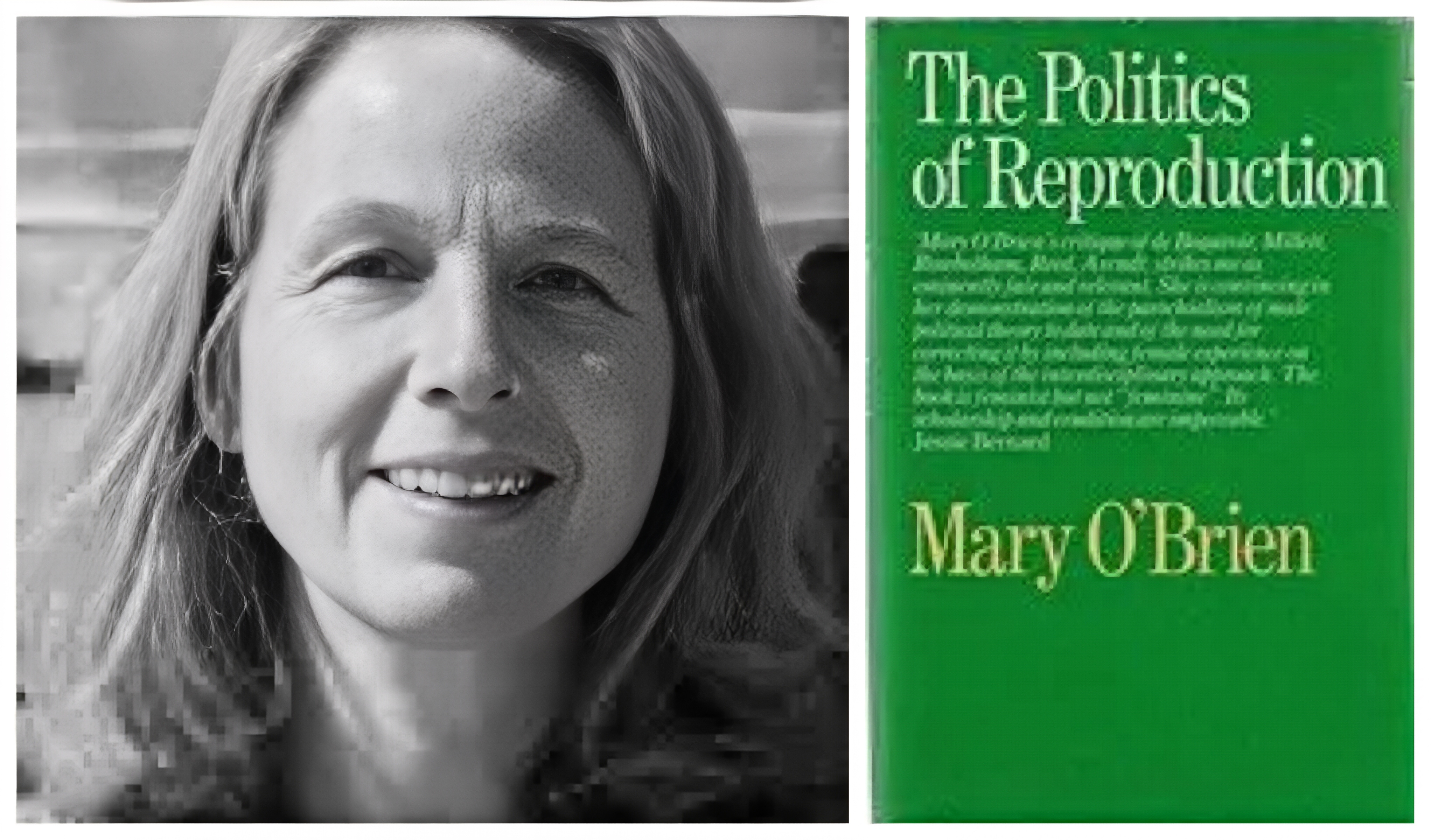
Mary Mamie O'Brien (1926-1998)
- English born, Scottish raised political philosopher, grew up in Glasgow 1930s, labour party member from teen years ("English by birth, Irish by name and Scottish by choice")
- Early activist: joined democratic socialist Fabian Society, Beatrice Webb influence, as a teen
- Midwife (early career)
- Immigrates to Canada 1957 and works as a nurse while completing graduate work in political philosophy
- 1966-1976 Moved through the ranks from lecturer to professor at Ontario Institute for Studies in Education (OISE) in Sociology and Education, Ontario (tenure 1976-1987)
- One of the founders of the Feminist Party of Canada (1979)
- Major work is The Politics of Reproduction (1981), marxist materialist account of reproduction that argues for reproduction and women's experience as fundamental theoretical concepts; Reproducing the World: Essays in Feminist Theory (1989).
I . Methodology
- "It is futile to complain to history for being what it has been. It is imperative, though, as Hegel sees so clearly, to understand what it has been, and for women that understanding must embrace the historical phenomenon of actual male supremacy." (p.187)
- Not cataloguing sexism (easy; skim PhilRights section 3)
- Constructive, not diagnostic; derive dialectic of sex-antagonism from early Hegel, outlast his own limited use of it
- Focus: early texts, System of Ethical Life, "On Love," early Phenomenology; not "congealed prejudice" of mature works
II. Creation of Man via Woman
- "Male supremacy is not established, as it were, in a 'one-shot' deal. It has to be worked at. Clearly, men have historically 'made' women." (p.183) I would add, it is an ongoing practice.
- Reappearance of the (Aristotelian) seed/tree analogy: "the tree is potential in the seed. We may note that he shares with male-stream thought in general a tremendous yearning to create a form of auto-regeneration that is superior to biological procreation..." (p.183)
- "the male desire for an all-male universe is not often expressed out loud." (p.185)
- But outside of being able to create life outside of reproduction, they can't kill/obliterate all women, only suppress. Men need women, specifically for reproduction, and it mortifies them; no reproduction, no cultural production either.
III.Paternity*
- "In effect, human continuity is removed from biological continuity, which women actively affirm in reproductive labor but from which men are alienated, to an artificial continuity in which men who have succeeded in 'making themselves' proceed to make historical continuity. Hegel's great merit is to see and acknowledge that the condition of man-made history is to suppress without actual negation the reality of reproductive process. Birth therefore remains privatized and takes place within time but outside of history... The separation of public and private life becomes a condition of history, rather than, as it actually is, a working structure of patriarchal hegemony." (p.187, my emphasis)
- Biology denies man immediate recognition of paternity
- Women don't need "principle of continuity"; create it concretely, via labor
- Neither Hegel nor Beauvoir considers reproductive consciousness: "Neither Hegel nor Beauvoir notice the crucial form of immediate recognition that biology denies to man, namely recognition of his particular paternity. Neither do they note that women do not need to create a principle of continuity, for they create continuity concretely by reproductive labor. But then, neither even addresses the possibility of a reproductive consciousness." (p.186-7)
- Hegel's real insight: man-made history requires suppression (not negation) of reproduction
- Male supremacy predates history (unlike class) → appears natural + rational (Nature rational for Hegel): "Male supremacy over women is established prior to the dawn of history, and is therefore presumably 'natural.'" (p.187)
IV. "Physiology is Fate", a Clever Inversion of Freud
- Not "anatomy is destiny" → "physiology is fate" (for men)
- Paternity conceptualized bc never immediate, "intransigent uncertainty," alienation of seed
- Maternity: no equivalent uncertainty, actual, unmediated dyad
- Separability itself gendered: seed separates from father; child (undifferentiated unity) separates only from mother
- Child is not a "self-generating entity" (contra Hegel); born via mother's conscious labor
- Man's finitude doubled: (1) ordinary mortality, (2) genetic stake "abrupted at ejaculation"
- Hegel's law is a historical apparatus managing this uncertainty (named explicitly below, via Hegel's own gloss on law as "the manhood of the community")
V. Death, War, Family
-
Death (not birth) gives man historical reality; a reversal O'Brien calls "weird" from woman's vantage
-
"The conditions of the birth of the self-constituted self, the self-made man, are the recognition of death and of other men. However, other men too desire to be recognized, and this conflict of desires, which is a desire of each for the desire of the Other, must be fought out in mortal combat... This Other (though Hegel does not say this specifically) becomes effeminate, in that he values mere life, his particular life, and eschews the Universalizing potentiality of the struggle to overcome and master Nature." (p.186)
-
Hegel's "Antigone fetish" is a final evasion of paternity puzzle
-
Hegel's law made to name what it manages: "in its efficient operation in general is the manhood of the community" (Phen., 496); O'Brien's gloss: "Law is indeed the efficient objectification of 'manhood.'" The payoff: "the uncertainty of paternity commands cooperation between men as a class: lay off my woman and I'll lay off of yours." (p.196)
-
Feminist theory now positioned to build a transcendental philosophy of birth/life that Hegel gestured toward, but couldn't complete

Antigone's Ghost: Undoing Hegel’s Phenomenology of Spirit
Kelly Oliver (1958)
- Straightforward academic career: University of Texas, Austin; Stony Brook University, W. Alton Jones Professor of Philosophy at Vanderbilt University, now emerita (retired).
- My dissertation chair
- Early feminist readings of Nietzsche, Kristeva and psychoanalysis, psychic space.
- Founder of the feminist philosophy journal philoSOPHIA
- Very prolific writer, also a successful mystery books author with three mystery series.
I. Main Thesis
- Stronger than "Hegel has sexist passages", this is a given
- Woman/family in "Ethical Order" section (PS) undoes entire project
- Phenomneology of Spirit committed to: all consciousness conceptually articulable; rational = real, real = rational; nothing legitimate stays permanently unspoken
- Woman is essential but in-principle unconceptualizable; not temporarily unconscious (like other dialectical moments pre-articulation), but unconscious by nature, on Hegel's own terms
- If so, system fails by its own standard
II. The Family's Double Function in Antigone
- "Natural ethical community," opposed to Nation (cultural community)
- Binds via unconscious/natural duties; yet duties only "ethical" once willed/conscious
- Bridge: unconscious nature → conscious culture, via blood ties + burial rites (rescue dead from nature, reinstall in community)
- Who does what: individual moved into culture = always male; laborer who moves him = always female
- Woman protects man's corpse from "unconscious appetites"; figures for nature itself, which she is identified with
- Protects him from what she embodies, "by remaining in the shadows"
III. No Redemption via Sublation
- slave's labor eventually returned to him as mastery
- Woman's "work leaves her nowhere"
- Sister has "highest intuitive awareness of what is ethical", but never attains consciousness of it; family law is inner, unspoken, exempt from real-world existence
- "The everlasting irony of the community", necessary and threatening
IV. Why Brother-Sister
- Husband/wife ruled out, love not law; reduced (via Hegel's own organ-metaphor elsewhere) to bodily, not conceptual
- Parent/child ruled out, too asymmetrical, too saturated w/ feeling
- Brother/sister: no dependency, no desire, "blood at rest and equilibrium"
- Irony: desire earlier enabled recognition (self-consciousness level); now its absence does same work
V. The Example Strains
- Antigone/Polynices modeled on incest-born siblings (Oedipus/Jocasta); Antigone's father is also her half-brother
- Scheme needs exactly one brother, one sister, achieved only via erasure
- Brother-brother = pure rivalry (Eteocles/Polynices kill each other)
- Sister-sister absent entirely, Ismene never mentioned
- "Loss of brother irreparable to sister", lifted from Sophocles' Antigone directly; no support for reciprocal duty
VI. Antigone's Impossible Position (via Irigaray)
- Knowingly commits crime against Creon's law; yet structurally unconscious of the ethical principle she acts on: guilty + ignorant at once
- Not master-slave dialectic, that requires fight-to-death between self-conscious equals (reserved for men)
- "Neither master nor slave", destabilizing; no place in the dialectic
- Sacrifice ends her, dies before marriage/founding own family; no one performs her burial rite
- Conclusion: no mutual recognition in this relationship at all
VII. Woman as Internal Enemy
- Human/civil law = identical w/ "manhood of the community"
- Community sustains itself by absorbing families, manufacturing "internal enemy, womankind in general" (must suppress)
- War: partly unifies community against threat of women's individualism
- Irony Hegel misses: in war, men absent, so women enter public labor; undoes the very split war was meant to enforce (e.g., WWII home front)
- Sexual difference doesn't submit to contradiction-logic, no resolution via mutual recognition
VIII. Conclusion
- Phenomenology of Spirit can't deliver its founding promise; feminine excluded in principle from conceptualization, therefore the real is NOT fully rational, by Hegel's own criteria
IX. Contemporary Extension
- 1990s "family values" rhetoric: blames domestic sphere for social breakdown, strips material support (welfare, healthcare, childcare)
- Asks women to nurture a public order that gives nothing back, treats their independent desire as threat
- Antigone, unburied by her brother, the ghost haunting the Phenomenology and Hegel's system
- Family-values politicians may find themselves similarly haunted
Lines Through these Feminist Thinkers
- All three thinkers treat Hegel's system as failing on its own terms rather than merely containing sexist content — Oliver via the "in-principle unconceptualizable" feminine, O'Brien via the buried anxiety about paternity, Lonzi via the master-slave dialectic's inapplicability to sex.
- O'Brien see something of value that can be rescued from Hegel, in the idea of reproduction-as-dialectical and calls on feminist to develop this (and her work does do). Lonzi wants to spit on and discard the philosophers who have already said enough, and calls for them to step down from protagonist role, and for a new subject (woman); and for Oliver, the system is haunted by the woman it cannot negate but only suppress. Irredeemable?