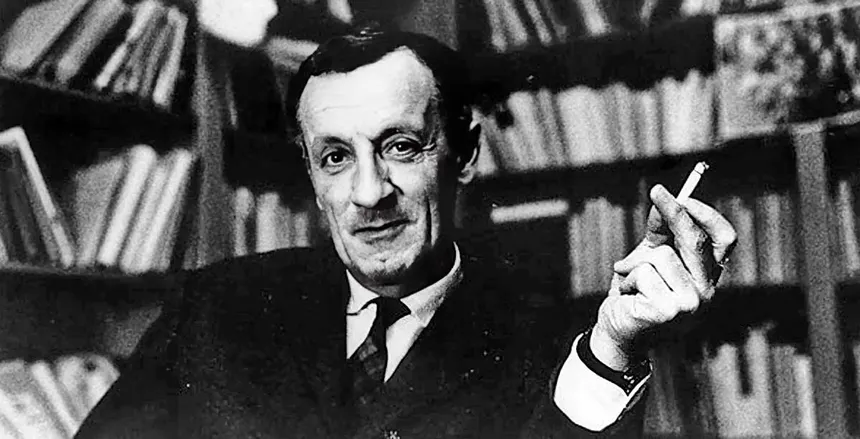
Born Rochefort-sur-Mer; father (colonial artillery officer) killed in WWI when little Maurice was just 5, raised by mother with whom he was very close; Roman Catholic.
Educated École Normale Supérieure (class of 1930), in the same class as Jean-Paul Sartre and Simone de Beauvoir
Served as infantry lieutenant in WWII, wounded in action June 1940, awarded Croix de guerre; active in Resistance group Socialisme et Liberté with Sartre
1940, married Suzanne Jolibois, a Lacanian psychoanalyst
Co-founded leftist journal Les Temps Modernes with Sartre and Beauvoir (1945), philosophy and literature answerable to the political moment; served as political editor until resigning in 1952 amid growing rift with Sartre/Beauvoir over Marxism/the Korean War.
Interdisciplinary thinker, interested in psychology, psychiatry, neurology, and visual art, may have authored a novel Nord under pen name Jacques Heller. He was first Chair of Child Psychology, Sorbonne (1949); then Chair of Philosophy, Collège de France (1952, youngest person ever appointed to that chair)
French Existential Phenomenology, Husserl and Heidegger major influences
Sartre's Being and Nothingness published 1943; Merleau-Ponty's Phenomenology of Perception (1945); Beauvoir's The Second Sex published 1949.
Tutored a young Michel Foucault ~1948
Korean War (1950–53)
Died suddenly in 1961 of an apparent stroke at just 53 years old (he was preparing a lecture on Descartes at the time, way to go)
The Visible and the Invisible (1964, posthumous, unfinished)
Existential Phenomenology via Edmund Husserl
Plato's Dualism
visible/material/immanent vs. invisible/immaterial/ideal/transcendent realms
body/soul division, the body belongs to the material world, and the soul to the immaterial, ideal realm.
Cartesian Mind/Body Dualism
res cogitans (thinking substance/substrate — unextended, indivisible, whose essence is thought)
res extensa (extended substance — spatial, divisible, whose essence is extension, governed by mechanical causation)
knowledge
the mind is known with absolute certainty via the cogito ergo sum (I think therefore I am)
the body is known only inferentially, as one physical object among others
questions emerge:
how can mind know about the material world, if these are radically separate and not overlapping "substances". This is an epistemological question, pertaining to how knowledge is possible.
how can mind affect body, if the two substrates have no common attribute or meeting point? how does the mindl move the body, and how does bodily affection reach the mind?
Brain in vat, etc.
how do we know we are not brains in vats experiencing some imaginary reality (is the world entirely in our heads) (God as evil genie)
how do we know we are not in a matrix, or a truman show ? How can we trust what we call "reality" of the world.
Responds to Descartes' mind/body dualism, which left us without a guarantee of knowledge of the world.
Everything we know (about the world) we know through our subjective experience of it.
Uncover the structures of that subjectivity
subjectivity is another name for mind/body taken together; another name used is consciousness (aka, Hegel)
there is not a mind/body divide because the subject is both mind and body, structured in a particular way
As subjects, we are both a material body (object, science, 3rd party perspective, subject to causality and extension, like Cartesian res extensa) and a lived body (inside out, 1st person perspective).
The lived body, which is how my own body is given to me as mine, in a first-person, lived from then inside-out perspective. It is your situation, your point zero of orientation around which other spatial objects appear.
LIFEWORLD and INTERSUBJECTIVITY
Method: account for what can be known once reality is granted, not prove reality first
he also begins from the assumption of a shared lifeworld, theory of intersubjectivity
the problem of the other is not about a dialectic of power, but a question of knowledge, of how we could know the Other
Other recognized as another Self, one who, like me, exerts their will on shared objects
Husserl fails to overcome Cartesian solipsism: Other known only insofar as like me, recognition via sameness, levelling of difference
My dog example: "Let’s take our dearest companions, dogs. Imagine if our relationship to dogs was based solely on how they are like us, and we cannot comprehend that they have their own needs and desires proper to their species, as well as individuality. Imagine that we can only recognize them in so far as they serve our purposes, needs, and desires. We are in a relation of mastery, lording over them an illegitimate power to define them through our terms. That our relation to many non-human animals is like this is sad, and we have to recognize that this is harmful to all involved. We miss out all the things that makes dogs wonderful since they are not human, and even the things they could teach us about who we are. Unfortunately, in this account, the Other is reduced to digestible parts, which is very much how a denial of difference attack is deployed: “You are no one and nothing to me unless you meet me in my world and on my terms.” It places beyond recognition anything that falls outside of norms that serve the powerful. Although not as conflictual as Hegel’s Master-Slave dialectic, this does not get us closer to a positive or productive encounter with difference."
Merleau-Ponty
Merleau-Ponty inherits and radicalizes Husserl's lived body, pushing the object/lived body distinction toward a non-dualist ontology of Flesh.
Lived Body (in a lifeworld)
Reversibility and Chiasm/Intertwining -- mediation
Flesh (later) - third term, in-between
"Prior to conscious thought, prior to an exchange with a particular Other, the human world is there for us. There is no human world that does not always already include others, and it would be very difficult to imagine a meaningful world devoid of others. Against Husserl, Merleau-Ponty points out that we are not, from the start, distinct from this world and others in it, but form a unity with them from which we later come to separate out our own individual subjective sense of self. In this way, our encounter with otherness is a condition for the possibility of our own subjectivity.
The mere existence of an Other takes us outside of our bodies and ourselves. As we are drawn into their world of concern, we forget ourselves and our concerns. We come to be out there in the world, and as Merleau-Ponty suggests, the world comes to inhabit us. In other words, the other doesn’t just present us with the data of other consciousnesses, but the other affects us and acts upon us in way that are similar to being love stricken."
REVERSIBILITY, my right hand touches my left hand, which is itself touching. The touching hand can, at any moment, become the touched hand. There's no pure touching subject and pure touched object — just a chiasm, a crossing-over, where the roles are reversible but never quite coincide (there's always a gap — Merleau-Ponty calls it an "écart" — which is why it's not a fusion). The same structure applies to vision: I see the visible world, but I am also visible within it — a body among bodies, seen by others, even by myself as an object. Seer and seen are of the same stuff.
FLESH, the flesh of the world: flesh is not matter, not mind, not body in either the Cartesian or the merely biological sense. Merleau-Ponty calls it an "element," in the pre-Socratic sense (like earth, air, water, fire), a general way of being that is neither purely subjective nor purely objective but the fabric from which both seer and seen, touching and touched, are cut. It's meant to name the being of which my body and the world are both articulations, so that the question "how does a subject reach an object" no longer needs the bridge Descartes needed, because subject and object were never two separate substances to begin with.
Mind the gap: écart
In all three descriptions, the gap remains between the two, so they don't collapse into each other. MP calls this écart (a divergence, a non-coincidence) between touching and touched, seer and seen.
A logical point here: Aristotle's logical principle that two bodies can't be in the same place and remain two, later referred to as the principle of impenetrability. Locke's later formulation: "it being impossible for two things of the same kind to be or exist in the same instant, in the very same place, or one and the same thing in different places." (Essay Concerning Human Understanding, Book II, Chapter 27, "Of Identity and Diversity")
Question: Why might feminist philosophers be attracted to Merleau-Ponty's Lived Body, and his concepts of the Chiasm/Intertwining?
Rejection of the abstract, disembodied knower
Return to the body as mattering to accounts of knowledge (where before it had been an impediment to knowldge)
phenomenological accounts of knowledge as embodied and situated (physically but also politically)
Through the body, gender also becomes significant, along with many other politically significant differences
Women have long been reduced to body; lived body is neither pure object nor pure consciousness, ambiguity or ambivalence reflects women's experience of being in a body
Intersubjectivity is built into subjectivity, perception and knowledge
An an account of asymmetrical subjects that leaves room for ambiguity and even cooperation, not just agonistic opposition
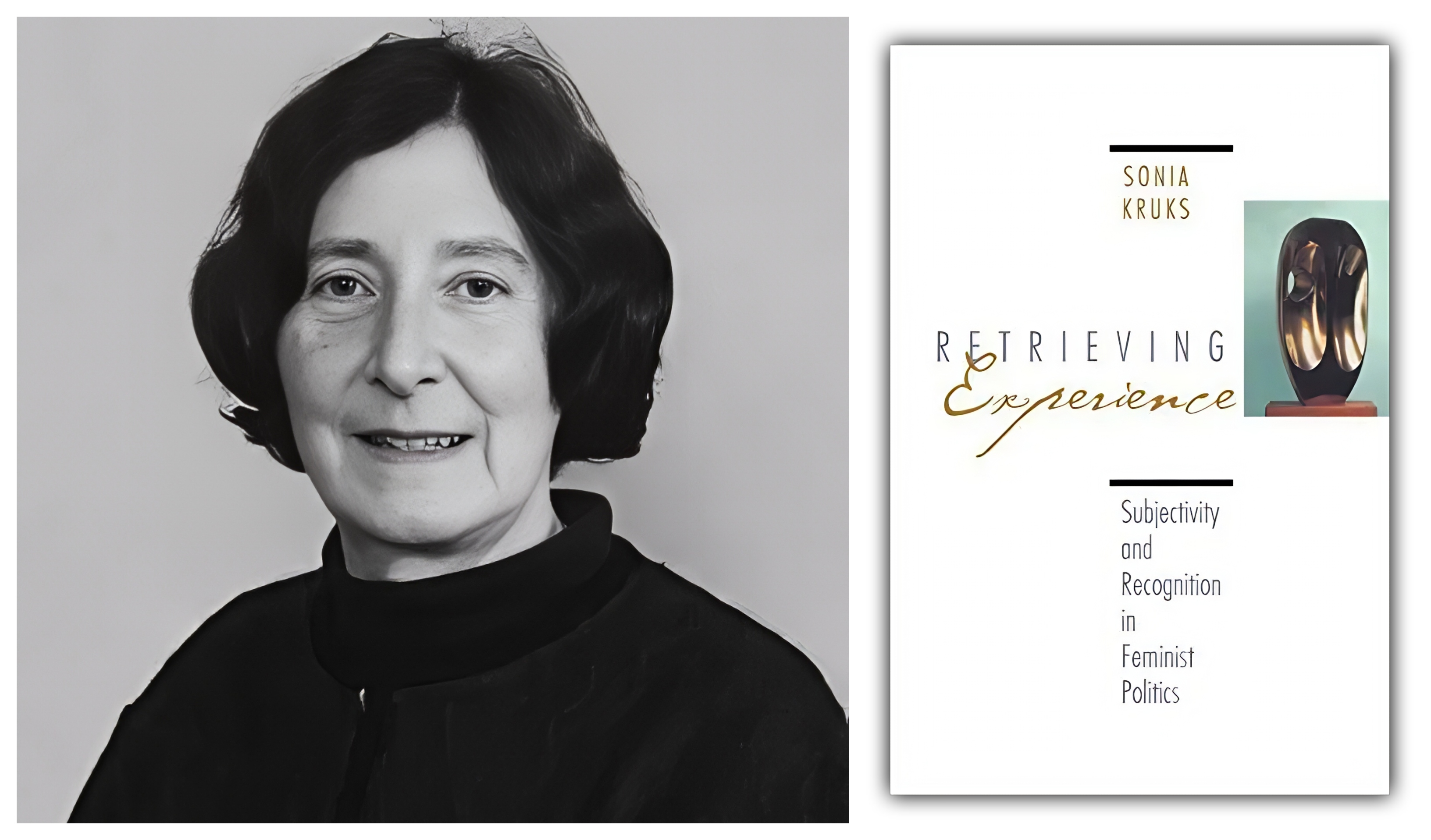
Sonia Kruks
Biography
Began career at the City of London Polytechnic in London -> Eduardo Mondlane University Mozambique -> moved to the United States in 1980.
Robert S. Danforth Professor of Politics Emerita at Oberlin College, a position held since 1990; also has served as Director of the Women's Studies Program at Oberlin.
Served on editorial boards of several journals, including PS: Political Science and Politics; Hypatia: A Journal of Feminist Philosophy; and Sartre Studies International. On Executive Board of the International Association of Women Philosophers.
Major Works: The Political Philosophy of Merleau-Ponty (1981); A Study of the Political Philosophy of Merleau-Ponty (1987); Situation and Human Existence: Freedom, Subjectivity and Society (1990); Retrieving Experience: Subjectivity and Recognition in Feminist Politics(2001); Simone de Beauvoir and the Politics of Ambiguity (2012);
Essay: “Merleau-Ponty and the Problem of Difference in Feminism.”
Opens with feminist critique of Merleau-Ponty as assuming a male body and subject in his account of subjectivity and 'primordial intersubjectivity' (c.f. Butler piece below)
Is much more positive on MP than most feminists, seeing a lot of resources in his theories for her own project -- building a non-essentialist political "we" for feminism.
"Merleau-Ponty has, of course, been accused by his feminist critics of expunging gender differences. It has been pointed out that his theory of embodied subjectivity, of the "body-subject," presupposes a generic body that is male, and that it excludes consideration of the way different social identities mark our bodies. Merleau-Ponty is said to offer an account of "human" existence in which embodiment may provide the ground for a "primordial" intersubjectivity only because he has, from the very start, erased differences.3 Merleau-Ponty does indeed present "the" body as masculine (this becomes most apparent, of course, in his discussion of the body in its "sexual being"). However, I shall argue that the sexism is not so constitutive of his theory as to preclude his work from being creatively taken up for feminist ends. On the contrary, I argue, his account of embodiment may accommodate, and indeed illuminate, gender (and other) differences that he does not dwell on himself."
I. The Embodied Body-Subject
"For Merleau-Ponty, human existence is first and foremost embodied existence. To exist is to be one's body; and this is to be a "body-subject," or a "sentient" subject·, and not the rational, autonomous consciousness so central to the Western tradition. But his concept of the body-subject does not presuppose, as some commentators have argued, our mysterious harmony with being. Rather it presupposes a paradoxical and ambiguous relationship, in which consciousness and materiality, subjectivity and the world of "things" are coextensive and co-constitutive. Such a relationship may be experienced as supportive and affirming of the self, but also as threatening and negating."
"To explore our existence as such a "third genus," Merleau-Ponty begins from our perception of the sensible world, or the "natural world." He initially suspends, or "brackets," its social qualities, but he does so only later to reveal the impossibility of doing so. Perception is not, as empiricist theory would have it, merely a passive reception of external stimuli. But neither is it, as Cartesianism or other forms of intellectualism would hold, an act of judgment (PP, 9). Rather, perception itself (and sensation more generally) is what he calls a "third" or intermediate experience. In our everyday perceptual experience of the world, perceiver and perceived are not a subject and an object. Blurring, they form a kind of "gestalt" or a "system" in which each calls the other into being (PP, 238-39)."
II. On the One Hand: Anonymous, Prepersonal Perception ("the One")
What we know we know, first of all, through our perceptive abilities. This is why MP and Kruks both start with an account of perception, first of all described as pre-personal and as not mine in particular, but belonging to the the world in which I find myself immersed.
"Because I am immersed, situated, in what I perceive, I cannot wholly control the field that "my" perception organizes around me. What I perceive has always a certain autonomy, a "generality," which escapes me. There is an "anonymity" to perception and to other sensory experiences, which means that they never are completely "mine." Rather, in the experience of sensation, I discover "a modality of general existence . . . which runs through me without my being its author" (PP, 216). ... In Phenomenology of Perception, Merleau-Ponty uses the term "the One" (l'On) to describe this anonymous, or prepersonal, embodiment that runs through my own embodied being and so decenters me. Strictly speaking, he tells us, "I ought to say that one perceives in me, and not that I perceive" (PP, 215). The perceiving self, he insists, "is not myself as an autonomous subject, but myself in so far as I have a body and am able to 'look'" (PP, 240)."
Notice here the centering of "looking" and vision as preeminent perceptive ability. Oliver will closely examine...
III. On the Other Hand: Perception as Always Already Social, Temporal, Particular
Embodiment is ambiguous, as we immediately find that this anonymity is always particular and situated from the start, spatially, temporally, and as part of an embodied-subject's intentional arc.
"For the things that we perceive also have such qualities as color, texture, weight-all of which we "perceive" together in the thing. For example, "a colour is never merely a colour, but the colour of a certain object" (PP, 313); and, in seeing the "woolly colour" of the carpet, I will also see it as "soft." Here, we quickly discover that my perceptual situation will already include a world of both personal and social meanings. The "woolly" softness of the carpet will carry personal and social significations for me. It may signify comfort, and perhaps luxury. It may recall other occasions or places to me, inciting memories or desires."
temporality:
"In addition, temporal dimensions inform even the simplest acts of perception. "Recollections" and "sediments," habitual ways of perceiving that originate in my prior perceptual experience and my general social existence-habits that may be imbued with my gender, for example-are part of what I bring to any situation. I also bring a future. For my perception involves my own movement towards a future, that is, my "project." "
intentionality (intentional arc):
"Merleau-Ponty describes the drawing together of these multiple dimensions of a perceptual situation in the notion of an "intentional arc" that "subtends" perception, as well as desire and cognition. It is such an arc, he says, "which projects round about us our past, our future, our human setting, our physical situation, our ideological situation, and moral situation, or rather which results in our being situated in all these respects" (PP, 136). Here we see how the prepersonal is always also particular; and how, in its particularities, it is always suffused with social significations."
IV. Intersubjectivity as Dialectical: Affirmation and Negation Both
Because embodied existence is this ambiguous mix of the shared and the particular, encountering another person is a dialectical event capable of affirming commonality, or of negating it.
"A mutually affirming intersubjectivity (which I will discuss first) exists insofar as I and another are both situated in, perceive, and can communicate about the same "natural" and "social" world. Even then we cannot ever have the identical perception, since we are separate existences, each a body-subject with its own unique situation. Yet there can be sufficient overlap between our perceptions to create between us an "interworld," a "primordial communication." ... our first move is to believe in an undivided being between us."
"This other is not, for me, a negating or objectifying transcendence, but an equal who shares with me, through our common participation in embodiment and sensation, and through our common world and history, a common perceptual experience."
V. Answering Judith Butler via Shannon Sullivan claim that an "anonymous" body is covertly solipsistic and dominating
Contra Shannon Sullivan, who argues: "that Merleau-Ponty's account of the anonymous body is not merely tacitly masculinist but is, moreover, solipsistic and dominating in import. She claims that by assuming, like Merleau-Ponty, that the body is neutral or generic, and that my perception is thus the same as another's, I effectively privilege myself as the site of perception"
AND
"that a "common ground" cannot be pregiven but is something we must strive for, especially through dialogue; for "there are no shortcuts provided by the body."2l"
Kruks argues:
"There are, self-evidently, certain dimensions to embodiment that most (though not all) human beings share irrespective of such differentia as sex, gender, race, or nationality."
"Unlike dogs, we see in color, for example, while the forward placement of our eyes precludes us from seeing as far behind us as most birds do. Our senses of scale and speed are a function of our size and the speed of the human gait-the latter being much faster than that of a tortoise, but slow in comparison to a rabbit.23 We cannot navigate by smell as some species can, have limited night vision, and so on."
"Such differentia are not merely biological "facts." Nor are they trivial. These invariants of hl!man embodiment structure our experiences such that we may recognize other human beings as sharing similar (though not identical) experiences to our own. If I see somebody running for a bus, struggling under a heavy load, or reaching to remove an object from a high shelf, for example, I will "know" roughly what it feels like. I will do so not through a process of rational construction, but prereflectively, through the immediacy of anonymous embodiment, through the prepersonal body as it runs through me."
"Likewise, I may immediately recognize another's most basic emotions as expressed in her or his body: if I see somebody weeping, that person's body will immediately communicate her or his grief to me.24"
"the prepersonal body"
"an indeterminate constancy," cf. Carol Bigwood
"But there do seem to be some "constant indeterminacies" of feminine embodiment within Western culture that offer similar experiences to women whose lives are also very different. For example, norms of privacy operate to present menstruation as a problem for women in Western societies, irrespective of their social class or their race. Moreover, the embodied temporality of menstruation is generally experienced as incommensurable with the temporal regime of the "normal" working and school day."
VI. Solipsism is Real but Non-Final Moment in Dialectic of Intersubjectivity
Solipsism is not to be denied, but is seen as a moment in the movement of the subject's encounter with the world and with others.
"Yet the initial solipsistic moment of this encounter is not to be dismissed as simply mistaken. On the contrary, in Phenomenology of Perception Merleau-Ponty argues that solipsism is a pervasive and significant aspect of our experience of others. I do tend, even prereflectively, to constitute another as merely a figure in my field of vision-until a sudden recognition of "reciprocity" decenters that perception (PP, 356-57). But even before such a decentering, the existence of other people presents me with difficulties. In solipsism I initially seem to transcend other people: they only exist for me as objects of my experience. But the problem is that I still cannot avoid recognizing them as "people" - that is, as beings "like myself." Less dramatically than the executioner's sudden discovery of himself in his victim, I still discover that people do not stand before me like other objects of perception, such as rocks or buildings. But recognizing them as people, even antagonistically so, then presents me with "the absurdity of a multiple solipsism" (le ridicule d'un solipsisme a plusieurs) (PP, 359).
A way out of this paradox that may be chosen - but that may also be refused; there are no guarantees - is to recognize that solipsism is but one "moment" of our relation to the world, and of the dialectic in which we may both deny and sustain one another. "Solitude and communication cannot be the two horns of a dilemma," Merleau-Ponty writes, but are rather "two 'moments' of one phenomenon, since in fact other people do exist for me" (PP, 359). For, finally, as we may realize, "the refusal to communicate is still a form of communication" (PP, 361)."
Kruks applies what she has learned from MP to the problem of difference in feminism and feminist politics. She thinks MP can give us a model for how to be together poltically without difference making communication impossible, and sameness flattening that difference.
Kelly Oliver (1958)
Biography
Straightforward academic career: University of Texas, Austin; Stony Brook University, W. Alton Jones Professor of Philosophy at Vanderbilt University, now Emerita (retired).
My dissertation chair
Early feminist readings of Nietzsche, Kristeva and psychoanalysis, psychic space.
Founder of the feminist philosophy journal philoSOPHIA
Very prolific writer, also a successful mystery books author with three mystery series.
Essay: “Toward a New Vision”
MP strikes a balance between the Husserlian account of recognition that depends on the Other being like me, and me being able to recognize them only in so far as they are like me; and on the other hand, Sartre's agonistic account of the Other as an immediate challenge to my subjectivity.
Merleau-Ponty insists that radical alterity requires neither that we are in conflict with others nor that we are forever cut off from others.
I. The Body as Both Subject and Object
The alternative isn't a better theory of recognition — it's rethinking subjectivity through the body itself, that returns to itself in its reversibility: toucher/touched, seer/seen
Rather than reject any philosophy of subjectivity, Merleau-Ponty rethinks subjectivity through the body.
The body is both subject and object "because a sort of dehiscence opens my body in two, and because between my body looked at and my body looking, my body touched and my body touching, there is overlapping encroachment, so that we must say that the things pass into us as well as we into the things" ( 1 968, 123).
Flesh makes communication possible because, as Merleau-Ponty says, it is the "reversible."
The skin is a boundary, but a permeable boundary.
The thickness of flesh and permeability of skin make "intercorporiety" possible ( 141); they make communication with the world and other possible ( 135).
There is always an un-closable gap between that prevents the collapse of difference, but that difference is what makes the communication possible.
This opening of the boundary It is precisely in this opening, which is our difference and the distance between us, that relationships and communication take place.
Empathy:
At this point, Merleau-Ponty suggests the radical notion that I can feel the other's pain. There can be an exchange of synergy between bodies, and if I am close enough to another person, I can experience the movements of their body in the same way that I experience the movements of my own.
I have a different relation to my own voice because it emanates from my body, and I am affected by the vibrations of my body as I speak: "But if I am close enough to the other who speaks to hear his breath and feel his effervescence and his fatigue, I almost witness, in him as in myself, the awesome birth of vociferation" ( 144).
II. Distance as Enabling, Not Alienating
Vision is made possible in the space between the seer and the seen.
It is that the thickness of the flesh between the seer and the thing is constitutive for the thing of its visibility as for the seer of his corporiety; it is not an obstacle between them, it is their means of communication” (1968, 135).
Rather, for Merleau-Ponty distance is enabling and vision is precisely how:“Vision alone makes us learn that beings that are different, ‘exterior, foreign to one another, are yet absolutely together, are ‘simultaneity’” (1964, 187).
For Merleau-Ponty the distance necessary for vision is not alienating but enabling because of the interconnection between the senses and the elements that make vision possible.
There are no gaps between us and the world, since we touch it with our eyes, working as they do in coordination with all of sensation.
III. Vision-Touch
We are not separated from ourselves, others, and the world by an abyss. If vision is part of a sensory system that includes what we take to be more proximal senses like touch, taste, or smell, vision becomes a sort of touching, a palpitation with the eyes.
If various interconnected, interacting elements-air, light, waves, particles, nerves, tissues-make vision possible, then distance is never empty space, an unbridgeable gap, or an abyssal void.
IV. Beyond Cartesian Space
MP is able to imagine vision as a form of touch because he has already rejected the Cartesian/modern view of space as geometrical, empty, inert, a void, along with the view from nowhere that is part of the God-trick a God's eye view from which Objectivity is launched. For MP space is full and thick, a medium through which we commune with the world.
Merleau-Ponty does not accept the Cartesian conception of space that privileges the perspective of some God’s-eye view on my seeing, what becomes represented in Lacan’s The Four Fundamental Concepts as the floating can that sees me looking.
Space is not made up of Cartesian points separated by infinite gaps between them in some geometrical arrangement. Rather, space is full of light and motion that cannot be located in any one point.
Merleau-Ponty criticizes Descartes' conception of space as "having no true thickness" ( 1 964, 17 4).
V. Perception is a Vision-Touch System
vision isn't an isolated sense surveying objects from outside, but interwoven with touch and the other senses — which is also why "seeing" someone can itself be a mode of touching them.
For him, vision is part of a system of sensation, and space is filled with the flesh of the world.
He describes palpitations of the eyes as analogous to tactile palpitations in what he calls a ““vision-touch system.” “Vision is a palpitation with the look” (1968, 134), and the world is visible because it is tactile.
He insists that the notion of the separation of the senses is misguided because all of the senses are interconnected in one body: each sense is really a complex of sensations that fundamentally implicates the others, and sensation operates in the reversible world of sensible and sentient, which folds the senses back onto themselves in a way that produces new levels of sensation and consciousness.
The senses translate each other and work together to form perception.
I do not see the world; I see according to it, with it. So, too, I do not see other people in the world; I see with them.
VI. Flesh of the World
"Flesh" is the fabric that makes vision, touch, intersubjectivity, and meaning itself possible — not just a body part, but what being and meaning are made of.
His notion of the flesh of the world is provocative in its implications for reconceiving of space as full rather than empty.
Humanity is the reversibility of flesh, an openness to the world, the eye’s welcome to the world.
Humanity is the intertwining of being and meaning, and the intertwining of visible and invisible is the relation between being and meaning.
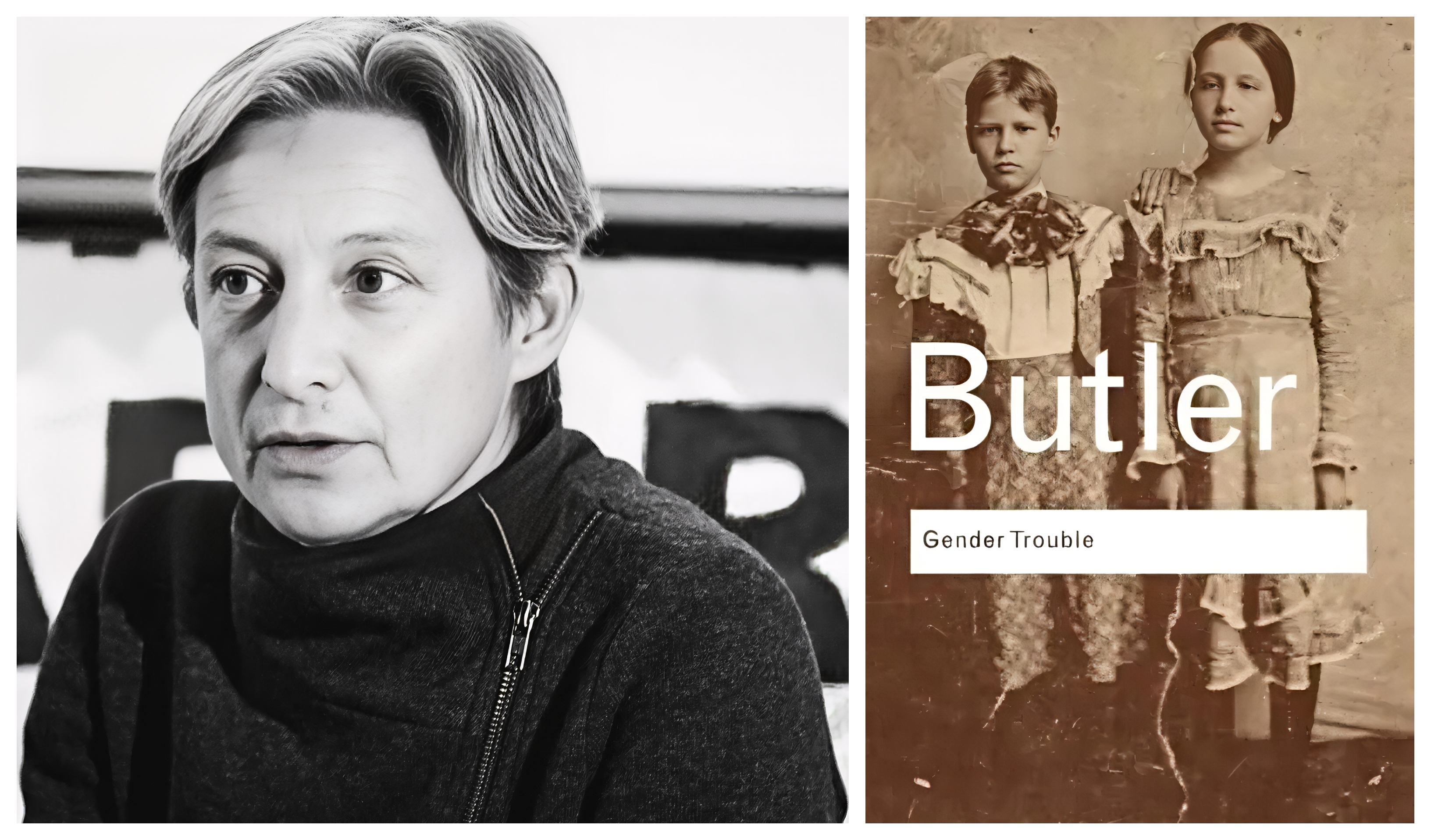
Judith Butler (1956)
Biography
Born to a family of Hungarian-Jewish and Russian-Jewish descent; most of their maternal grandmother's family was murdered in the Holocaust
Father was a dentist; mother was an advocate for fair housing
Attended Bennington College before transferring to Yale, receiving BA (1978), MA (1982), and PhD in Philosophy (1984)
Trained in Hegel, phenomenology, and French post-structuralism at Yale
Taught at Wesleyan University, George Washington University, and Johns Hopkins University (receiving tenure at Johns Hopkins in 1992) before joining UC Berkeley. Maxine Elliot Professor of Rhetoric and Comparative Literature at UC Berkeley in 1998; Hannah Arendt Professor of Philosophy at the European Graduate School in Saas-Fee, Switzerland.
A lot of major works: Subjects of Desire: Hegelian Reflections in Twentieth-Century France (1987); Gender Trouble: Feminism and the Subversion of Identity (1990); Bodies That Matter: On the Discursive Limits of "Sex" (1993); Excitable Speech: A Politics of the Performative (1996); The Psychic Life of Power: Theories in Subjection (1997); Antigone's Claim: Kinship Between Life and Death (2000); Frames of War: When Is Life Grievable? (2009); Parting Ways: Jewishness and the Critique of Zionism (2012); The Force of Nonviolence: An Ethico-Political Bind (2020); What World Is This? A Pandemic Phenomenology (2022); Who's Afraid of Gender? (2024)
Essay: “Sexual Ideology and Phenomenological Description: A Feminist Critique of Merleau-Ponty's Phenomenology of Perception”
I. The Ideological Structure of "Abstract Subject, Concrete Experience"
"The ideological character of The Phenomenology of Perception is produced by the impossible project of maintaining an abstract subject even while describing concrete, lived experience."
"... Merleau- Ponty prefigures the analysis of lived experience, investing the body with an ahistorical structure which is in actuality profoundly historical in origin."
II. Abstract Subject is Secretely Male
By failing to historicize sexuality or ask whose body is being described, it ends up universalizing a culturally male subject as "the" human subject, devaluing both gender as a category, and women.
"Devoid of a gender, this subject is presumed to characterize all genders. On the one hand, this presumption devalues gender as a relevant category in the description of lived bodily experience. On the other hand, inasmuch as the subject described resembles a culturally constructed male subject, it consecrates masculine identity as the model for the human subject, thereby devaluing, not gender, but women.
Merleau-Ponty's explicit avoidance of gender as a relevant concern in the description of lived experience, and his implicit universalization of the male subject, are aided by a methodology that fails to acknowledge the historicity of sexuality and of bodies. For a concrete description of lived experience, it seems crucial to ask whose sexuality and whose bodies are being described, for 'sexuality' and 'bodies' remain abstractions without first being situated in concrete social and cultural contexts. Moreover, Merleau-Ponty's willingness to describe a 'natural sexuality' as a lived experience suggests a lamentable naivete concerning the anthropological diversity of sexual expressions and the linguistic and psychosomatic origins of human sexuality. In the end, his version of 'lived experience' commits the fallacy of misplaced concreteness, giving life to abstractions, and draining life from existing individuals in concrete contexts."
III. Masters and Slaves
Merleau-Ponty's account of sexual desire reproduces Hegel's master-slave dialectic, which they interpret as: desiring makes one a subject (a "master," pointedly without a body) and being desired makes one an object (a "slave," a body without desire).
"Master-slave is thus a metaphysical dynamic insofar as a body is always an object for others inasmuch as it is perceived. Perception designates an affective relation and, in the context of sexuality, signifies desire. Hence, a body is an object to the extent that it is desired, and is, in turn, a subject, inasmuch as it desires. Hence, being desired is equivalent to enslavement, and desiring is equivalent to mastering. Taken yet further, this dialectic suggests that the master, as the one who desires, is essentially without a body; indeed, it is a body which he desires to have. In other words, active desire is a way of dispensing with the existential problematic of being a body-object. In phenomenological terms, active desire is a flight from em- bodiment. The slave is thus designated as the body that the master lacks. And because the slave is a body-object, the slave is a body without desire. Hence, in this relationship, neither master nor slave constitute a desiring body; the master is desire without a body, and the slave is a body without desire.
We can speculate yet further upon this 'metaphysical' structure of bodily existence. The desire of the master must always be the desire to possess what he lacks, the body which he has denied and which the slave has a body —much less a person who desires. Whether or not the slave desires is irrelevant to the master, for his desire is self- sufficient; it posits the object of its desire and sustains it; his concern is not to be a body, but to have or possess the body as an object. But what does it mean to say that the master does not have a body? If the body is a "situation," the condition of perspective and the necessary mediation of a social existence, then the master has denied himself the condition for a genuine presence in the world and has become worldless. His desire is come to embody. The slave, on the other hand, is not a person expressive of consciousness thus both an alienation of bodily existence and an effort to recapture the body from this self-imposed exile, not to be this body, but this time to possess and control it in order to nurse an illusion of transcendence."
...the slave's desire would constitute a fatal contradiction in the slave's identity. Hence, the liberation of the slave would consist in the moment of desire, for desire would signal the advent of a subject, a body expressive of consciousness."
IV. Deconstruction, Then Feminist Appropriation
A feminist critique must trace these structures back to their concrete cultural origins, but a feminist appropriation of Merleau-Ponty is also possible: if the body's existential themes are read as gender-specific and historicized, sexuality becomes a site of cultural struggle and change. They are careful to add that working this out belongs to feminist philosophy still to come, not to Merleau-Ponty's own text. Here we see why we did all this work, what they find of value in MP.
"A feminist critique of Merleau-Ponty necessarily involves a deconstruction of these obfuscating and reifying structures to their concrete cultural origins, and an analysis of the ways in which Merleau-Ponty's text legitimates and universalizes structures of sexual oppression. On the other hand, a feminist appropriation of Merleau-Ponty is doubtless in order. If the body expresses and dramatizes existential themes, and these themes are gender-specific and fully historicized, then sexuality becomes a scene of cultural struggle, improvisation, and innovation, a domain in which the intimate and the political converge, and a dramatic opportunity for expression, analysis, and change. The terms of this inquiry, however, will not be found in the texts of Merleau-Ponty, but in the works of philosophical feminism to come."